


- Category
- Hot products
.jpg)
-
Swing vs Lift vs Butterfly Check Valve: Principle, Pros and Cons
-
1. What is a check valve?
The check valve is an automatic valve that mainly relies on: the flow pressure of the medium itself to achieve automatic opening and automatic closing.
When the medium flows forward, the check valve opens.
When the medium stops flowing or a reverse flow occurs, the check valve automatically closes.
Therefore, the core function of the check valve is to prevent the medium from flowing back.
2. Principle of one-way flow of medium
The principle of the check valve can be understood in one sentence: open with forward flow and close with reverse flow.
1) When flowing forward
When there is positive flow in the pipeline, the medium pressure acts on the valve disc. The forward pressure overcomes the self-weight of the valve disc, spring force or friction. The valve disc is pushed open and the medium passes through the valve. At this time, the check valve is in the open state.
2) When the flow stops
When the flow stops or the forward flow decreases, the force pushing the valve disc decreases. The valve disc will begin to close under its own weight, spring force or return pressure.
3) When reverse flow occurs
When the downstream pressure is higher than the upstream pressure, the medium has a tendency to flow in the opposite direction. Reverse pressure will press the valve disc toward the valve seat. The valve disc fits the valve seat, the valve closes, and the backflow of the medium is prevented.
3. Swing check valve
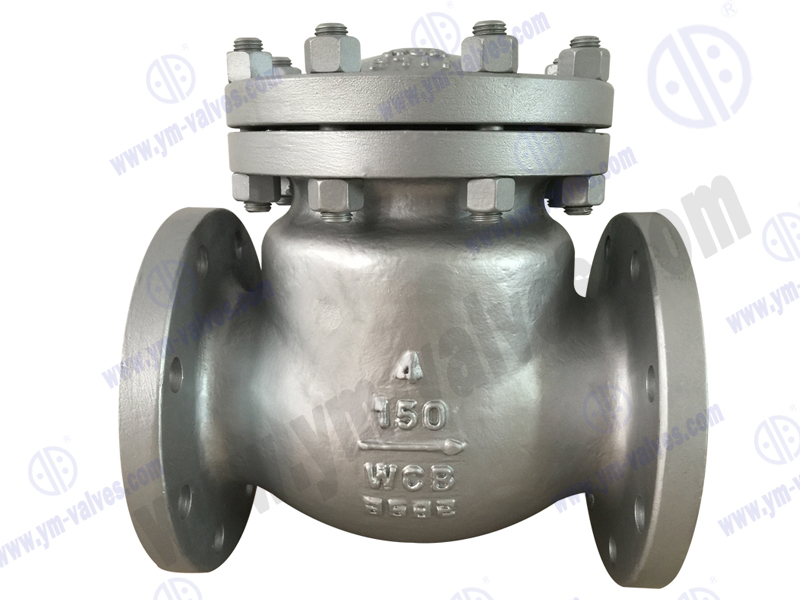
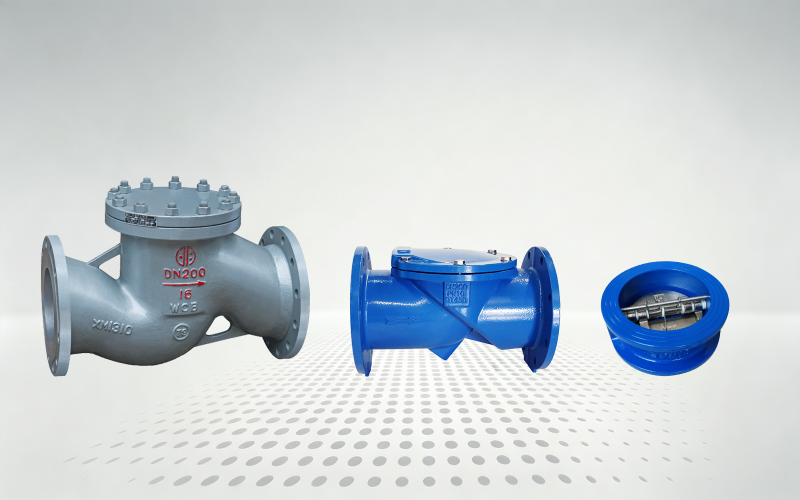
Swing check valve is a common type of check valve in chemical industry sites. Its disc rotates around a pin to open and close like a door. During forward flow, the medium pushes the valve disc to swing upward. During reverse flow, the valve disc falls back to the valve seat under the action of its own weight and reverse pressure.
Features of swing check valve
· Swing check valve is suitable for: large diameter pipelines, low pressure drop requirements, liquid pipelines, outlet pipelines, horizontal installation pipelines
· Advantages: simple structure, small flow resistance, suitable for larger diameters, strong flow capacity
· Disadvantages: relatively slow closing speed, prone to water hammer, valve disc may hit the valve seat, not suitable for frequent pulsating flow, high installation direction requirements
· Common problems: valve disc stuck, pin wear, valve disc is not closed tightly, sealing surface erosion, valve disc impact produces noise, water hammer occurs when the pump is stopped
4. Lift check valve
The valve disc of the lift check valve moves up and down along the internal guide structure of the valve body. During forward flow, the medium lifts the valve disc. During reverse flow, the valve disc descends and compresses the valve seat. Its action is similar to the lifting and lowering of the valve disc of a globe valve.
Lift check valve features
· Lift check valve is suitable for: small diameter pipelines, high pressure pipelines, steam pipelines, gas pipelines, horizontal pipeline installation
· Advantages: good sealing, compact structure, suitable for high pressure and small diameter, direct closing action
· Disadvantages: Large flow resistance, large pressure drop, medium cleanliness requirements, impurities can easily cause jamming, not suitable for large diameter low pressure drop occasions
· Common problems: The valve disc is stuck, the guide part is worn, impurities are stuck on the sealing surface, the valve disc is not closed tightly, and the flow resistance is too large, resulting in significant pressure drop
5. Butterfly check valve
Butterfly check valve is also called wafer check valve or double-disc check valve. Its structure is shorter and lighter in weight. During forward flow, the medium pushes the two valve discs to open. During reverse flow, the spring and reverse pressure cause the valve disc to close quickly.
Butterfly check valve features
· Butterfly check valve is suitable for: large diameter pipelines, limited space occasions, circulating water systems, cooling water systems, fire water systems, clamping installation occasions
· Advantages: short structure, light weight, easy installation, fast closing speed, suitable for large diameters
· Disadvantages: There is a certain resistance in the valve disc and spring in the flow channel, the spring may be fatigued or damaged, the sealing surface is easily affected by impurities, and it is not suitable for all high temperature and high pressure working conditions
· Common problems: spring breakage, valve disc jamming, valve disc not closing in place, sealing surface wear, clamping installation inconcentricity, valve disc vibration and noise
6. Summarize
Check valve is a very important protection valve in chemical industry sites.
Its core principle is: forward flow is opened and reverse flow is closed.
1) The main function of the check valve is to prevent medium backflow, prevent pump reversal, protect the compressor, prevent system backflow, and reduce the risk of equipment damage
2) Common types include: swing check valve, lift check valve, butterfly check valve, ball check valve, silent check valve
3) Common faults include: lax closing, failure to open, jamming, valve disc impact, water hammer, backflow, and reverse installation direction