


- Category
- Hot products
.jpg)
-
Comparison of Four Mainstream Industrial Valve Flange Gasket Types
-
Four types of mainstream gaskets
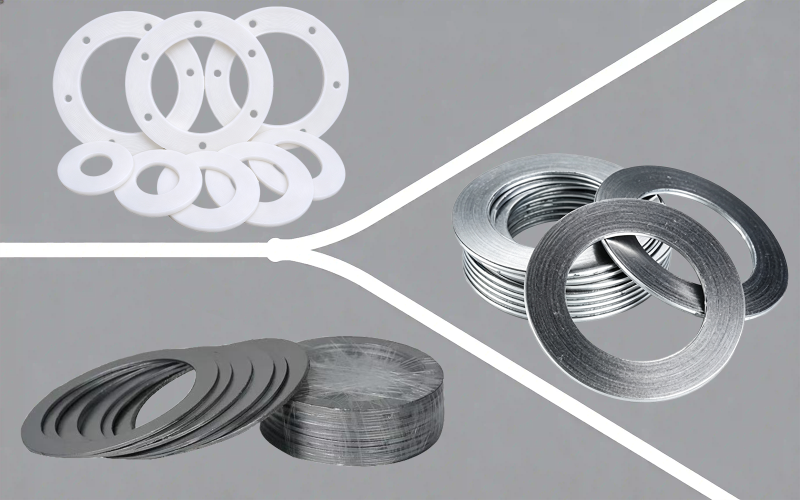
1. Flexible graphite pad
Flexible graphite is made by pressing natural graphite through acidification and high-temperature expansion treatment - it is still graphite in essence, but it is made into soft and compressible sheets.
Applicable boundary: temperature -200~550°C (up to 650°C in non-oxidizing environment), pressure generally up to Class 600. Water, steam, oil, and most chemicals can be used.
Weakness: Afraid of strong oxidizing media. Nitric acid and fuming sulfuric acid will directly oxidize graphite into CO₂.
Installation Note: The graphite pad is brittle and cannot be bent. When installing, it should be placed flat on the flange surface.
2. PTFE pad (polytetrafluoroethylene/teflon)
The biggest feature of PTFE is its chemical inertness - it is almost not corroded by any chemicals and is completely immune to strong acids and alkali solvents. Therefore, PTFE is the first choice for acid and alkali pipelines in chemical plants and solvent pipelines in pharmaceutical plants.
Applicable boundary: temperature -200~200°C, pressure generally up to Class 300. Above 200°C, PTFE begins to soften and deform.
Shortcoming: cold flow deformation. The so-called cold flow means that under the combined action of temperature and pressure, PTFE is slowly squeezed out of the flange surface like plasticine - the higher the temperature and the greater the pressure, the faster it is squeezed out.
Solution: If the temperature exceeds 200°C, switch to a metal wound pad or filled with modified PTFE (adding glass fiber/carbon fiber filling can improve cold flow resistance, but chemical compatibility will be compromised).
3. Metal wrapping pad
The structure of the metal winding gasket is "metal belt + non-metal filler belt alternately wrapped" - the metal belt provides resilience and the filler belt provides sealing. The most common one is 304 stainless steel V-shaped steel belt + flexible graphite filling.
Applicable boundary: The temperature range depends on the filling material (graphite filling -200~550°C, PTFE filling -200~200°C), and the pressure can cover Class 150 to Class 2500. Suitable for almost any medium.
Core advantage: good rebound. The flange will undergo slight relative displacement under temperature and pressure fluctuations, and the metal wound gasket automatically compensates for it by relying on the elastic energy of the V-shaped cross-section - something neither flexible graphite nor PTFE can do.
A rule that is easily overlooked: metal winding pads must be replaced with new ones after disassembly and assembly. The steel strip was plastically deformed when it was pressed for the first time. If it is reused, the shape of the sealing surface will not match, and the leakage rate will rise sharply.
4. Metal ring gasket
The metal ring gasket is a ring processed from a single piece of metal - it is not sealed by filling material, but relies on the interference fit between the metal ring and the trapezoidal groove of the flange to form a line contact seal.
Applicable range: temperature -200~650°C, pressure is generally used above Class 900, and is the standard configuration of high-pressure valve flanges.
Core principle: When the flange bolts are tightened, the metal ring is pressed into the trapezoidal groove of the flange. The contact surface generates extremely high contact stress - exceeding the yield strength of the metal material. The microplastic deformation of the ring surface fills all the microscopic gaps in the groove. Therefore, RTJ gaskets can theoretically achieve zero leakage.
Installation key: The surface of the flange trapezoidal groove and metal ring must be free of any scratches. Use a magnifying glass to check the ring groove before installation. The hardness of the ring must be lower than the hardness of the flange (otherwise the flange groove will be crushed).
Material matching: carbon steel flange with soft iron ring (≤Class 600), stainless steel flange with 304/316 ring, high pressure hydrogenation with Inconel 825/625 ring.
Three practical points
1. The thickness of the gasket is not as thick as possible. Under the same bolt torque between 1.5mm and 3mm graphite gaskets, the 3mm gasket has greater compression and better initial sealing - but the rebound loss after long-term high-temperature operation is also greater, making it easier to leak. Recommendation: 1.5mm is used under general working conditions, and 3mm is used only when the flange surface is in poor condition (with slight corrosion pits).
2. There is a formula for installation torque. ASME PCC-1 gives two key coefficients of gaskets: m value (minimum gasket coefficient) and y value (minimum sealing specific pressure, unit MPa). Bolt pretightening force W = π×d×N×y + design pressure×π×d²/4. There is no need to calculate by hand - but you need to know the existence of this formula, and tighten it against the torque table given by the gasket factory during installation.
3. Graphite gaskets are not coated with sealing grease, PTFE gaskets are required, and metal ring gaskets are absolutely not allowed. Graphite itself has self-lubricating properties. Applying sealing grease will actually reduce the friction → the gasket will slip → it will not be compacted tightly. The surface of PTFE is too smooth, so applying a thin layer of grease will help the gasket stay in place without deviation. The metal ring is coated with sealing grease = contact stress is buffered by the oil film = sealing failure.